
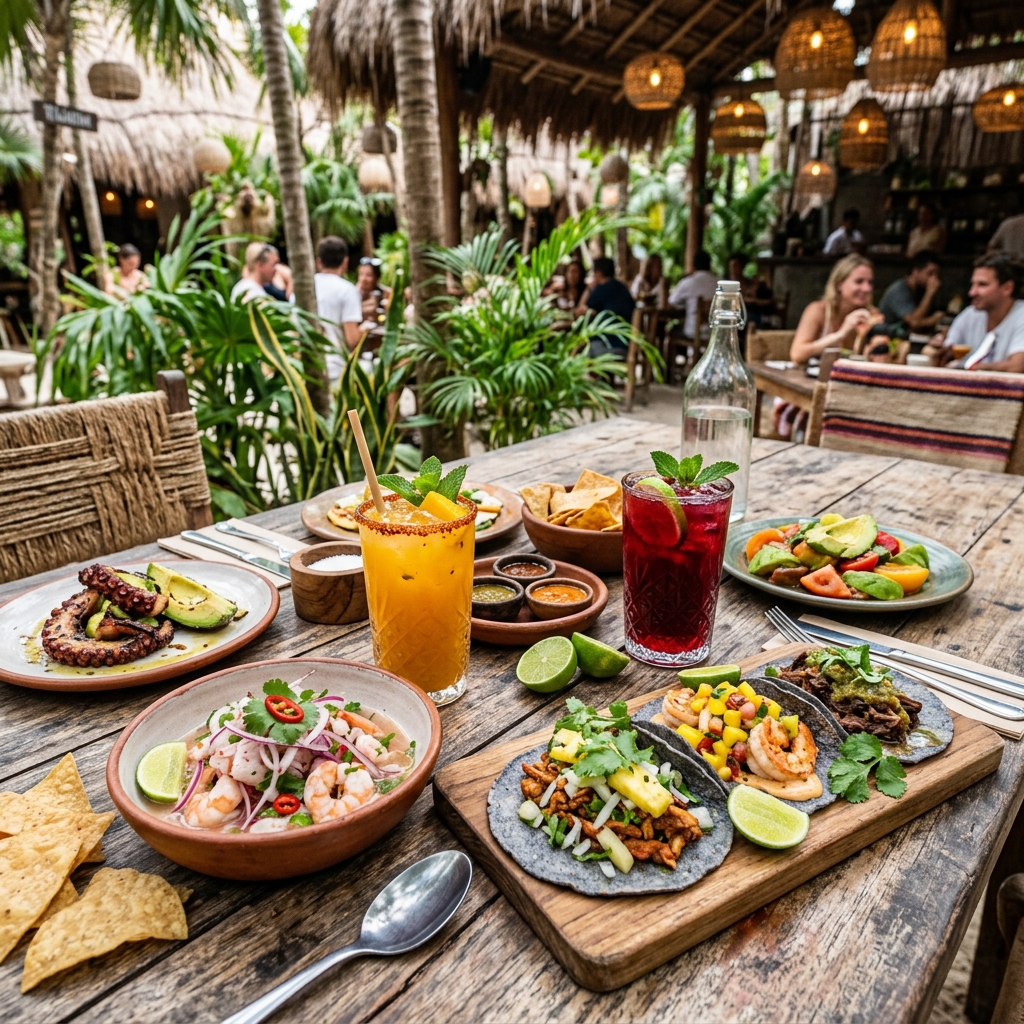
Tulum has the most talked-about restaurant scene on the Riviera Maya, driven by the combination of internationally connected visitors, a community of serious chefs who relocated specifically to cook in Tulum, and local ingredients — fresh seafood, Yucatecan produce, traditional Maya cultivars — that are exceptional. Here's how to eat well across the full spectrum.
The wood-fire cooking movement
Tulum became a culinary destination largely because of Hartwood — the restaurant opened by Eric Werner and Mya Henry in 2010 that used no electricity (generators and grid power were unavailable in the early hotel zone), cooking everything over wood fire with locally sourced ingredients. This constraint became a philosophy and then a brand, and Hartwood has influenced the character of Tulum's food scene more than any other single establishment. The wood-fire approach is now found at multiple hotel zone restaurants. The quality of the technique — managing fire temperatures for different ingredients — varies significantly between operators.
The local ingredient advantage
Tulum's proximity to both the Caribbean (fresh fish and seafood daily) and the Yucatecan interior (recado negro, achiote, local chile varieties, chaya — a leafy green native to the region — and heirloom corn varieties) gives its restaurants access to exceptional local ingredients. The best hotel zone restaurants have direct relationships with local suppliers and change their menus seasonally. The worst hotel zone restaurants import everything and charge local prices for international ingredients.
Tulum Pueblo food culture
Tulum Pueblo (the actual town, 2 kilometers from the hotel zone) has a functioning local food culture that operates entirely independently of the international restaurant scene. The daily market, the comida corrida fondas on the main street (Av. Tulum), and the taco operations that have been feeding residents for decades are here. A full meal in Tulum Pueblo costs $80–200 MXN per person. The same caloric and nutritional equivalent in the hotel zone: $500–1,500 MXN. The quality gap between the best Pueblo restaurants and the average hotel zone restaurants is minimal.
The breakfast culture
Tulum hotel zone breakfast is an Instagram-optimized experience — açaí bowls, smoothies, and avocado toast at $200–350 MXN per plate. Some of it is genuinely good. None of it is better value than the breakfast tortas, huevos, and fresh juice available at Tulum Pueblo's morning food stalls for $60–120 MXN. The exception: if you're staying in the hotel zone and the access to Pueblo requires a taxi, the calculus changes. But if you're in range, the Pueblo market breakfast is the better decision 9 times out of 10.
What to eat specifically
At Hartwood or Arca: whatever is on the menu that day — both restaurants list their menu by what's available, not what they've decided to serve indefinitely. At El Camello Jr.: the ceviche and the whole fish. At Taquería La Nave: al pastor. At the Pueblo morning market: huevos con chaya (eggs with the local native green) and fresh-made tortillas.
