
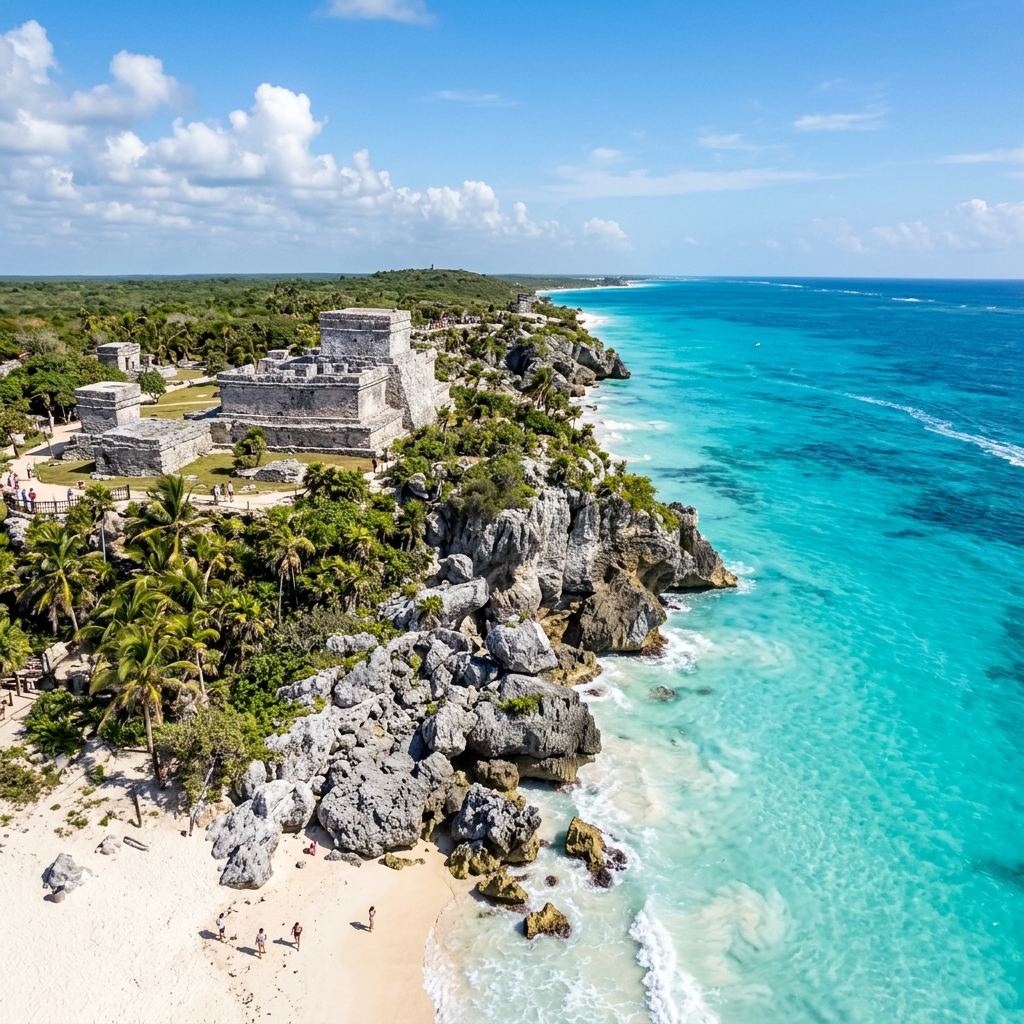
The Tulum Archaeological Zone is the most visited Maya site in Mexico — not because it's the most historically significant (it isn't) but because it combines dramatic setting (cliff above the Caribbean), accessibility from a major resort destination, and manageable scale (you can see the entire site in 2 hours). Here's how to visit it well.
The historical context
Tulum was a Maya walled city that flourished between 1200 and 1450 CE — a relatively late period in Maya civilization. It was primarily a trading port connecting the Caribbean coastal trade routes with inland centers. The walls (the name "Tulum" means "wall" or "fence" in Yucatec Maya) protected the city on three sides; the fourth side was the cliff above the sea. Unlike Chichén Itzá or Cobá, Tulum was not a major ceremonial or political center — it was commercial infrastructure. Understanding this helps make sense of why the structures, while dramatic in setting, are less architecturally elaborate than the major inland sites.
The main structures
El Castillo: The tallest structure in Tulum (12 meters), built on the cliff edge with a direct view of the Caribbean. It served as a lighthouse — the window alignment creates a light effect that guided canoes through the reef break directly below. The building is roped off but you can walk to within 5 meters of it.
Temple of the Descending God: The most distinctive iconographic element at Tulum — a figure descending head-first that appears in carved relief over multiple doorways. The Descending God is associated with the setting sun, rain, and bees. The original carved version is inside the main inner sanctum; reproductions are elsewhere on site.
Temple of the Frescoes: The best-preserved painted structure at Tulum. The interior murals (visible through windows; entry to the interior is restricted) show Maya cosmological imagery in vivid original color. The exterior carvings include images of Ixchel (moon goddess) and Kukulcán (feathered serpent).
The beach: At the base of the cliff, accessed by stairs from the archaeological zone, there's a small protected beach where the original Maya trading canoes once landed. Swimming is permitted. The beach is small — 30–50 meters wide — but the setting (beneath the ruins, protected bay, Caribbean blue) is extraordinary.
Practical logistics
Buy tickets online in advance at inah.gob.mx — entry is $571 MXN (federal) plus approximately $100 MXN (state fee). The online reservation system limits daily entry, and during peak season (December–March, July–August) walk-in tickets may not be available. Site opens at 8am. Arrive within 30 minutes of opening for manageable crowds. By 10am, cruise ship groups from Cozumel and tour buses from Cancún and Playa del Carmen fill the site.
